It might be known by most readers of the Blög that there is a new bicycle company in town, by the name of TUNK, in which I (aki) play a substantial role in, being one of the three founders, designers and directors.
Right now I wanted to use my little soapbox here as a platform to promote Tunk, as I have invested most of my free time and quite frankly all of my assets into this bicycle manufacturing company, and thus would like it to succeed. To clarify, the entity of Tunk Bicycles is not owned by the same co-operative as Töölön Pyörä, even though the project did originate from the co-op. A complete historical account will be given some time later, somewhere, so let’s not go into that now.
I wanted to build a bridge between Tunk and the Blög, without only running an advertisement, but by presenting a history lesson to our dear readers as well. Thus I present here the article “La Randonneuse”, written by my spiritual mentor in the bicycle business, Vélocio, which I have translated into English. It was originally published 116 years ago in Le Cycliste to promote a bicycle model of the same name from the brand La Gauloise.
This company was the worldly-business-side of the erudite philosopher-cyclist that was Vélocio. One needs to eat, and even the simple vegetarian diet of theirs, along with a taste for the finest “extra soft clincher tires” costs something. Only very few can attain the state of not having to eat the five grains, and of using cheap tires, and can thus wholly and completely devote themselves to philosophy. Instead they might have to resort to designing, manufacturing and selling bicycles!
Why advertise a contemporary bicycle with some ancient material, you may ask. This Randonneuse that is being introduced, “the mount par excellence of hikers of the Ecole Stephanoise” (Vélocios small circle of cyclist friends), is one of the very first bicycles designed for fast long distance bicycle touring. The first Tunk model, the Hike-Use, is a direct homage to, and emulation of its original cyclotouring spirit, made to inspire similar adventurous tours: for good health, endurance, holistic growth and contemplation. Both are built on the same founding principles: to be able to go far quickly, with comfort, and all the while self-supported, facing the conditions of the road with confidence! To showcase the original idea will also support our own cause, the continuation of the lineage.
To briefly explain the etymology, the word Randonneuse (with my limited understanding of French, as a possible gender-neutral term the synthetic form randonnaire could be proposed?) is derived from randonnée, meaning a hike, which again means a brisk long walk. Vélocio was most probably the first to use this word in the context of cycling, to describe their long bicycle trips, I would guess to differentiate them from shorter outings, parisian promenades, slow walks, and on the other hand from pure sport that the coureurs, directly translated as runners, also known as racers, did. As a cyclocultural side note, I really like the categorization of different pedaling efforts into walking, hiking and running, it feels to me very descriptive.
The riding of Vélocio was of the vast and long sort, and not necessarily what most people would consider traditional athleticism, even though the physically demanding nature of the rides is very evident: just see below the example of riding 480km from Nice to St. Etienne in a day! How I see it, to experience Nature was the rides’ purest spiritual cause, and to prove the bicycle a worthy tool of the greatest economy of locomotion was the every-day main quest. This ethos rings throughout most of Vélocios writing and I have to admit is ringing in my own head most of my waking time.
I’m assuming Vélocio projects their words for a cultured audience of cyclo-touring amateurs, or at least they are trying to convert you into becoming one. Take for example the invocations of softness and responsibility for one’s machine, in opposition to the brute force of the professionals and those imitating them, which bring to mind the great concept of mechanical sympathy. Of which I think I heard for the first time in an interview of the late Charlie Cunningham (Ride in Peace!), the bicycle designer legend, in the Rivendell Reader (no 27, Summer 2002), another important part of my bicycle education. (all RRs can be found HERE) This sympathy is to ride with the bicycle, not just force it to work for you. And to know its limits and to take good care of it.
The important point to take away here is the fact that everything in bicycle design is a compromise. There are no free magicks that would make a bicycle best and undefeatable in every way and for every one. Also our Tunk Hike-Use frameset is designed with this in mind, and mostly the same compromises have been made as La Gauloise did for the advertised bicycle model: comfort and long distance performance being the functions that the form must follow, while indestructibility is given up in the bargain. Horses for courses, bicycles for rides.
Advances in materials since 1910 have made it possible for a light steel-framed bicycle to be much stronger, so not all of Vélocios warnings on careful riding apply. Still I feel a lot of bicycle frames today, especially those made of steel for “general purpose riding” are fairly overbuilt, so that they can withstand any abuse thrown at them without the maker having to worry about warranty claims of clumsy riders. It is easier of course for a manufacturer to make frames heavy and strong, and claim that they are “comfortable all-rounders” due to some magic comfortable quality of steel as a material, even though there is such a lot of the material used that the bike ends up being quite stiff and heavy!
Of course for many people and for many uses a strong, stiff and heavy frame is a valid approach, just not for those looking for something special and highly refined. A light, springy frame and fork, along with lightweight components, give the responsible cyclotourist looking to cover vast distances a beautiful mixture of speed and comfort.
Lastly, for the historically technical context of the article, consider that pneumatic (air-filled) tires were now standard, the freewheel mechanism was still a novelty, lightweight parts made from aluminium and special steels were only slowly being developed, and such refinements of the bicycle as brakes or gear-changers were still primitive. But all of this of course only fueled the creative fire within a bicycle designer and avid cyclist such as Vélocio.
La Randonneuse
published 1910 in Le Cycliste -magazine
Translated from French by Aki with the help of big G
This will be the new product of the “La Gauloise” in 1910. I am its father and that is why I believe I must present it myself without hiding any of its qualities or its defects. I will even take the opportunity to tell a few truths which, if better known, would spare cyclists from useless complaints.
As its name indicates, this bicycle will be the mount par excellence of the hikers of the École Stéphanoise, and will allow any cyclist capable of staying twenty-four hours in the saddle to go from Saint-Étienne to Nice in a day, that is to make an hourly average of 20 to 21 kilometers, stops included, always without abnormal fatigue. (Translator’s note: 20km/h x 24h =480km. Corresponds to about the shortest possible route from Nice to St. Étienne)
For a shorter journey, this average could very well rise to 25/26 km/h and even higher; because the “Randonneuse” is much closer to the high-performance racing machine, than to a very comfortable gala carriage. (TN: The speeds given here are very respectable, impressive even today. Taken in context it means this: if you follow Vélocios teaching: have a healthy lifestyle and good vegetarian diet, practice cycling regularly and have the correct bicycle, you can do it.)
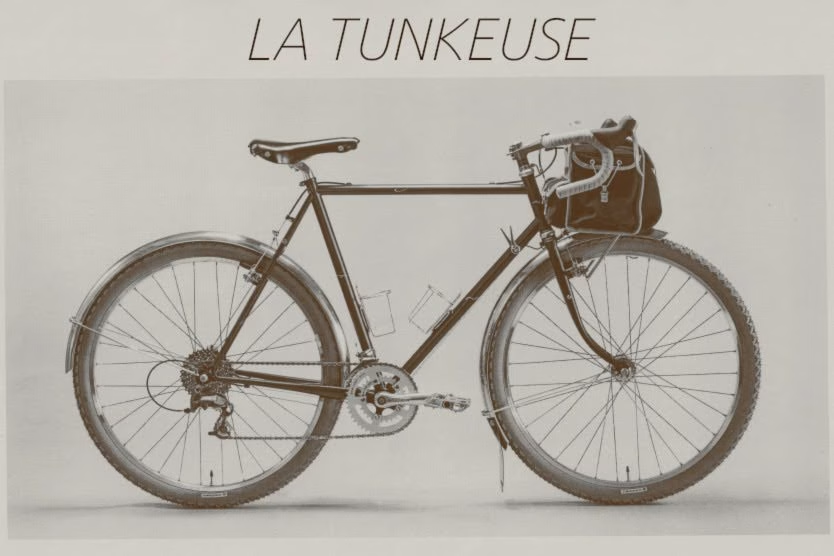
In terms of comfort, it is summed up as this: 35 mm bead tires (TN: meaning clincher tires if I’m not mistaken), extra soft, very prominent outside the wooden and aluminum rim; very light wooden mudguards; a saddle with some spring, and even, for delicate kidneys, a vaguely elastic, oscillating, or cushioned seat post, two developments: 6 and 4 meters. (TN: two speeds with approx. 42-16 and 42-24 gearing) by two chains and foot clutch; a freewheel and a pincer brake on the rear rim.
For all the rest, the ”Randonneuse” is directly derived from the racing machine; it is stocky, with a low frame (height 55 cm), compact 65 cm wheels, short base of 40 cm between the axles of the pedal crank and the drive wheel; it has a narrow pedal crank (axle of 11,5 cm); with 16,5 cm cranks facilitating fast pedaling cadences (80 to 100 rpm); and it weighs 12,5 kg.
(TN: wheel size is measured most probably including the tire, which would make the wheels something like a 584mm rim with 35mm tires, almost exactly like on the medium sized Tunks. The ‘base’ is the chainstay length, pedal axle probably equals the “Q-factor”, as cottered axles of the time would be usually flush with the outer surface of the usually completely straigh, crank arms. All the details here indicate a good performance bicycle.)
This means that it is capable of resisting any pressure of the foot on the pedal, on a level or on an ascent but it is necessary, on the descent, when passing through gutters, on cobblestones and on very bad roads, to know how to spare it a little. The handlebar, which I have not said anything about, can be chosen ad libitum, but if you want my opinion, I lean towards the simple straight handlebar of 48 cm width, which suits me wonderfully and gives me an average position, which I must be content with, not having the double handlebar (TN: meaning sweep/drop bars with two positions).
You have to know how to limit yourself, and I estimate at 3 kg the overload in comfort that the ”Randonneuse” already carries which, equipped absolutely for racing, would weigh only 9,5 kg. (TN: overload in comfort means multiple gears, brakes, mudguards, lamp etc, things that add weight but are not absolutely necessary for riding, but are for touring comfort) This is to say that it will have to be treated with as much care as a racing bicycle of this minimal weight, if we want it to last.
Professionals mistreat their machines, that is understood; but they are replaced or repaired. The École Stéphanoise hikers, not enjoying such advantages, will know, I hope, how to be economical with their own goods, and make themselves light on their light mount, by standing on the pedals, in the roughest dungeons you might venture in. If I had to preface some catalogue, I would be careful not to tell my future customers what most manufacturers assure them without flinching: that my machines are unbreakable, unadjustable, proof against any accident, whatever the way in which they are handled, the weight that is inflicted on them, and the shocks that are made to them.
I would rather tell them (especially when it comes to bicycles weighing 9,5 kg, like the ”Randonneuse” in racing gear, that is to say, relieved of its three kilos of comfort which weigh it down without making it too heavy): that this machine has been manufactured with the greatest care so that it can perform the regular rapid transport service on good roads for a long time, for which it is intended.
And it will do this service, on condition that you spare it on bad roads, that you avoid collisions with trees, mileposts and even large stones, that you do not lend it to ”hundred kilos” since it is made for average weights of 65 to 75 kilos, that you ride it lightly, and not like a sack of flour, etc…
(TN: Velocio writes of “good roads”, but one must consider the time, and how bad a bad road in 1910 must have been like! Paved roads pretty much did not exist. Also note that only one frame size is offered, corresponding to the second smallest Tunk, which tells about the average height of people then and now. This also explains the weight limit of 75kg)
I have seen cyclists, not devoid of intelligence, surprised beyond expression because, after having bumped at 10 km/h, they told me, obliquely against a milestone, their frame had warped! A head-on impact, however slight, when the cyclist remains in the saddle, is enough to bend the two tubes of the frame or the steering fork; when the impact is oblique, the entire frame undergoes an inexplicable deviation for those who do not know what force inertia incorporates into a mass of 80 kg. in motion. This, true for a strong road bicycle, is even more so for a light racing bicycle and any cyclist who believes himself qualified to ride a ”Randonneuse” must fully understand this truth: that one must take care of their mount…
If the cyclists I am talking about should be surprised by something, is it not rather to see a tool as light, as frail as a bicycle, resist for so long the enormous work imposed on it? What other means of locomotion can be compared to it? The extraordinary resistance of this assembly of steel tubes and wires baffles all calculations, and empiricism had to get involved, because never would theory and science itself have dared to entrust a ten-kilogram vehicle with the task of transporting a hundred-kilogram individual at 40 km/h and even more on the descent of the Col de Porte in Grenoble, to name just one.
All manufacturers guarantee their machines, that is understood; but it is still necessary to understand what they mean by guarantee. They guarantee their machines against all construction defects, without this guarantee being able to entail, for them, any other obligation than that of the repair or replacement free of charge of parts recognized as defective; and on the condition that the defect does not come from negligence, abuse, lack of care, and, a fortiori, accidents.
For those who can read between the lines, this means that we do not guarantee that the forks, tubes, rims, etc., will never break, that the cones, cups and balls will never get pitted, that the chains will never break, etc.
I would therefore advise, first of all, never to set off without, as I never fail to do myself, ensuring that the fork crown and the steering tube are free of any cracks, that the tubes do not come loose in the fittings, that the nuts are all tight, especially those that secure the wheels and the handlebars, that the control of my gear changes is well adjusted, that the cables or the multiple-nut rods of my brakes are not likely to let go at the critical moment. In less than five minutes, when you’re used to it, you can review your machine from head to toe, because 99 times out of 100, fortunately, there’s nothing unusual.
The catalogues go by too quickly on the dangers that lack of care and supervision can cause cyclists. These, I know well, would risk being sent away by the manufacturer who wanted to enlighten them in this brutal way, and would go and buy from the dealers who guarantee their machines for five years regardless of how they are treated, but who take care to change the neighborhood, or shop sign every six months, so that we no longer find them when we invoke their generous guarantee.
Let us therefore learn to accept our share of responsibility and when, by a brutal and ill-timed effort, we break a chain, or when, letting ourselves fall heavily on the saddle, we demolish a spring, let us only blame our own clumsiness, let us not resemble the ”pedards” who boast of tearing off their handlebars, of twisting their cranks: ”Huh! are we strong?” You are only clumsy and brutal!
They would do better to learn to round off their pedal stroke; to pull only moderately, and in the proper direction, on the handlebars; to spare their mount, and to use it as a tool of locomotion and not as a game of massacre. The effort that one makes to twist a crank or break a freewheel pawl is lost for propulsion, and the really good cyclists are those who go a long way with their bicycle, and not with marmalade. (TN: the meaning of the marmalade part is lost on me, it surely is not meant literally)
So, let it be well understood that the ”Randonneuse” is made for hiking at high speed, on average roads, whatever the slopes; but that, on bad roads and especially on descents, it must be ridden with more precautions than a heavy poly-travel cycle, which has absolutely opposite qualities and defects.
VELOCIO.
Huge thanks to velotextes.fr for keeping alive the spirit of cyclotourisme and digitizing the article!
If you are not familiar with Tunk Bicycles, you can find the website and blog at tunkbicycles.com. To continue on the same theme, I recommend you read the “Design Philosophy” article (link), also written by me.
For those unfamiliar with Vélocio’s life and works, if you can read Finnish, you can see my article on them in the blög HERE. For the English-reading audience, you can start with the classic Clifford Graves article, found HERE, which covers the basic education and provides a satisfactory understanding of the philosophies of Vélocio and the Ecole Stephanoise. More articles can be found in past issues of Bicycle Quarterly -magazine.